Role
Product Design
Client
Studio Project
CaliCount Market
CaliCount Market

OVERVIEW.
CaliCount Market reimagines grocery shopping as a calorie-aware experience. Every product is labeled by calorie content, not just weight. Scan a QR code, and your total calorie intake is automatically calculated and synced to your phone — no manual logging required.


THE PROBLEM.
Traditional calorie tracking apps require users to manually log every meal after the fact. The friction is too high. CaliCount embeds tracking directly into the shopping experience.
Traditional calorie tracking apps require users to manually log every meal after the fact. The friction is too high. CaliCount embeds tracking directly into the shopping experience.

THE RESEARCH.
THE RESEARCH.
How a typical supermarket is structured product categories and customer traffic flow. Understanding the physical environment to designing a calorie-labeling system that could realistically integrate into existing retail spaces.
How a typical supermarket is structured product categories and customer traffic flow. Understanding the physical environment to designing a calorie-labeling system that could realistically integrate into existing retail spaces.

THE CONCEPT.
THE CONCEPT.
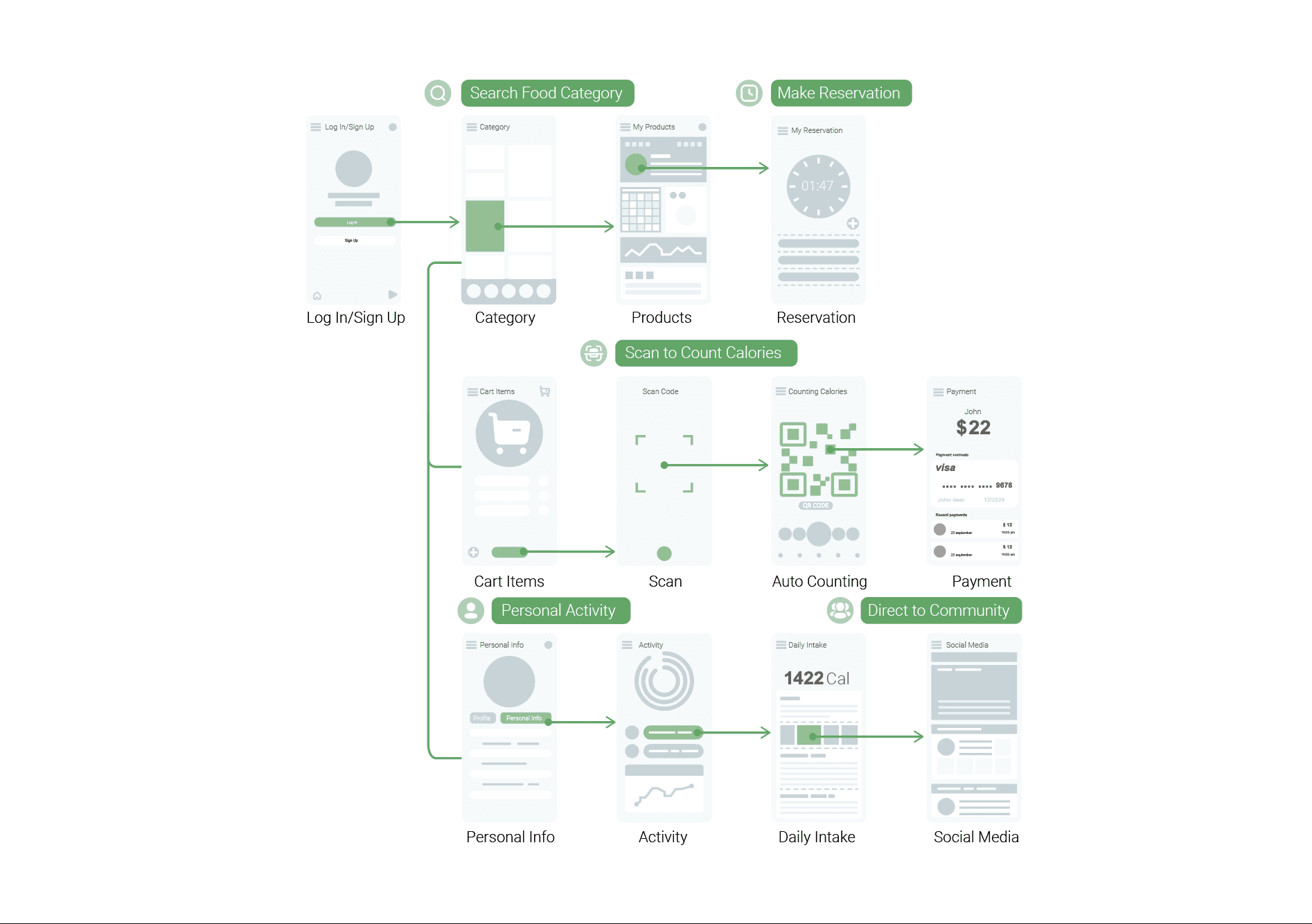
Each product carries a calorie label and QR code. Scanning at checkout automatically tallies the day's intake and syncs to the mobile app. The system removes the cognitive load of tracking by making it happen passively, as part of shopping.
Each product carries a calorie label and QR code. Scanning at checkout automatically tallies the day's intake and syncs to the mobile app. The system removes the cognitive load of tracking by making it happen passively, as part of shopping.
APP WIREFRAME.
THE DESIGN.
The system spans three surfaces: a wearable device, a companion app, and a physical publication. Each touchpoint reflects a different dimension of the experience. The body, the interface, and the archive.
The system spans three surfaces: a wearable device, a companion app, and a physical publication. Each touchpoint reflects a different dimension of the experience. The body, the interface, and the archive.